

Servo Drive Overheating Persists? Before Replacing the Heatsink, Check the Diode in the Freewheeling Loop
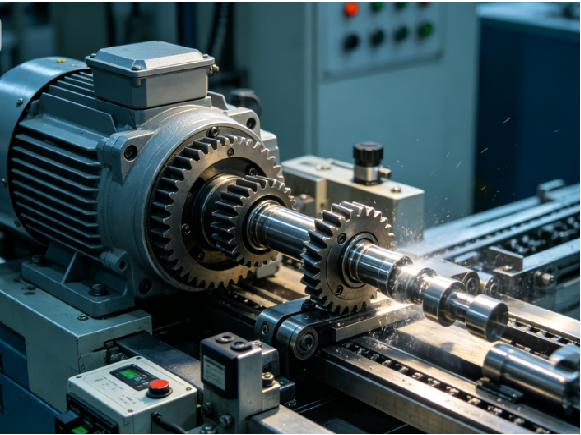
When a silicon-based fast recovery diode (FRD) turns off, the minority carriers stored in the PN junction require time to be swept out, forming a reverse recovery current spike. In servo drives with a 16–20 kHz carrier, this “backwash” repeats every PWM cycle; the loss produces no torque and only turns into heat, suppressing power density. SiC Schottky is a majority-carrier device, and its reverse recovery charge Qrr approaches zero, physically removing the excitation source of this loss.
What quantifiable changes does SiC Schottky bring to servo freewheeling?
Under operating conditions with frequent motor starts/stops or commutation, SiC SBDs can reduce switching losses by about 30%, making them particularly suitable for high-frequency PWM control scenarios in servo motors. At the system level, after replacing IGBTs with SiC modules, the total energy loss of the servo system can be reduced by about 41%, and the drive's own heat generation decreases accordingly, giving the cooling system an opportunity to migrate from forced-air cooling to natural-air cooling. Another characteristic directly relevant to current expansion through paralleling is the positive temperature coefficient: when the temperature of a parallel branch rises, the on-state voltage drop increases, and current automatically transfers to the cooler branch, mechanistically suppressing the current concentration that the negative temperature coefficient of silicon devices may cause.
For low-voltage servo buses (48–200 V class), which two models are worth evaluating first?
HS8MBRH200N2X100 and HS8MBRH300N2X100 share the M31H package and 200 V VRRM, but differ in their trade-offs between current rating and on-state voltage drop, corresponding to two typical servo power-stage design approaches.
The 200 A class is suitable for single-device or small-parallel architectures. HS8MBRH200N2X100 has a VFM of 1 V and an IFSM of 1650 A, providing a balanced on-state loss baseline at the 200 V / 200 A operating point; it is suitable for freewheeling and braking circuits of low-to-medium-power servo axes, or as a basic unit in multi-device parallel configurations.
The 300 A class is suitable for high-current single-device paths or parallel designs with higher margin. HS8MBRH300N2X100 reduces VFM to 0.75 V while increasing IFAV to 300 A and IFSM to 2000 A. In servo braking conditions with a relatively high freewheeling duty cycle, reducing VFM from 1 V to 0.75 V means conduction loss drops directly by 25%—combined with the benefit of SiC eliminating reverse-recovery loss, this allows the 300 A model to carry a larger continuous braking current under the same cooling conditions, or to leave a higher thermal safety margin without enlarging the heatsink. For compact multi-axis servo drives, this 0.25 V drop difference ultimately shows up in cabinet temperature rise and heatsink size.
Both models are Non-isolation SBDs. The M31H package is more straightforward to install in a common-ground bus layout, and the mechanical interface modification cost when replacing silicon FRD modules is controllable. For the complete product portfolio and parameter filtering entry point, refer to the Hypersemi SiC Schottky module category page.