

5G Base Station PSUs Under Thermal Stress: How SiC Locks Down Thermal Runaway
A Reliability Defense Line from Positive Temperature Coefficient to Low Leakage Current
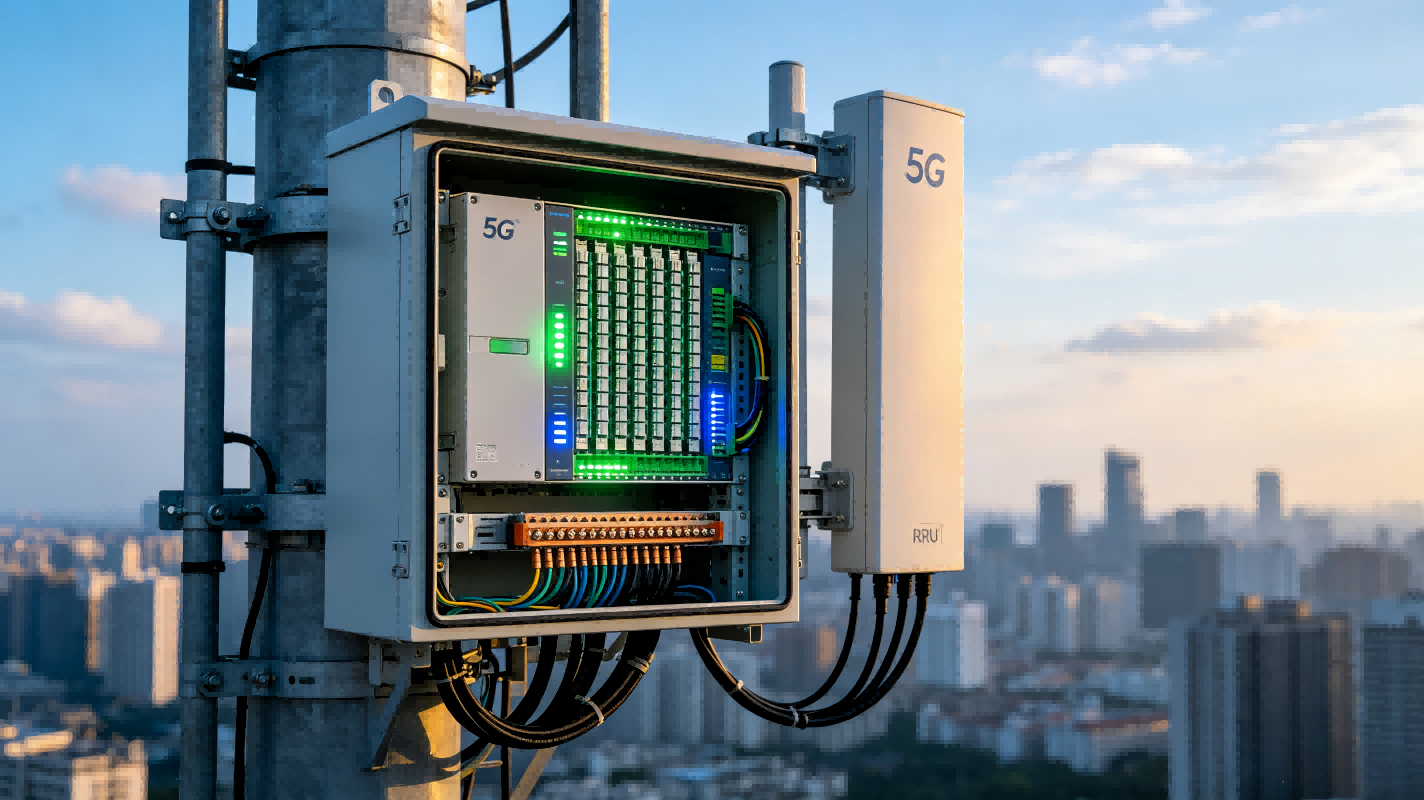
5G base station PSUs operate outdoors at ambient temperatures above 85°C, and MTBF roughly halves for every 10°C rise in component temperature. The leakage-current escalation and negative temperature coefficient of silicon diodes at high temperature are hidden drivers of thermal runaway. SiC Schottky diodes, with positive temperature coefficient and low leakage, shift parallel current sharing from passive dependence to active stability, providing a calculable defense line for telecom PSU reliabi
The design constraint for 5G base station PSUs differs fundamentally from other power scenarios: it must operate in an environment it cannot choose. Outdoor cabinets, tower-top installations, and sealed compact enclosures push internal temperatures above 40°C in summer, while the PSU module itself may approach 85°C or even 100°C. The industry rule of thumb is that PSU MTBF roughly halves for every 10°C rise in component temperature. Reliability design for 5G PSUs is, at its core, a sustained contest with temperature.
In this contest, the diode is often not the most visible device, but it is the most fragile link in the thermal runaway chain. The reverse leakage current of silicon fast-recovery diodes (FRDs) and silicon Schottky diodes climbs exponentially at high temperature, and the leakage loss in turn heats the die, creating a local hot spot. When multiple diodes are paralleled, the negative temperature coefficient of silicon Schottky further concentrates current in the hottest die, closing the positive feedback loop of thermal runaway. The high-temperature environment of 5G PSUs provides the most favorable trigger conditions for this chain.
SiC Schottky diodes enter not as a simple “material swap,” but as a physical-mechanism-level dismantling of this thermal runaway chain.
Positive Temperature Coefficient: Turning Parallel Sharing from “Luck” into “Mechanism”
SiC Schottky diodes exhibit a positive temperature coefficient (PTC) over the normal operating current range: as temperature rises, forward voltage VF increases. This seemingly small characteristic carries decisive engineering significance in paralleled configurations.
When multiple SiC SBDs are paralleled and one die runs hotter due to a local hot spot, its rising VF forces current to shift toward the cooler devices. The redistribution suppresses further heating of the hot spot, and current sharing is achieved by the device’s own physical behavior rather than relying entirely on PCB layout symmetry or external balancing circuits. For the multi-device paralleled rectification or PFC boost stages common in 5G PSUs, this means the thermal runaway positive-feedback loop is interrupted at the device level.
It should be noted that the PTC advantage holds under steady-state operating current. Under transient forward surge conditions, the device may enter bipolar conduction mode, where PTC no longer guarantees current sharing. Selection for 5G PSUs should therefore use steady-state high-temperature conditions as the primary calculation scenario, with surge boundaries verified separately.
Low Leakage Current: The Baseline Value of “Not Adding Fuel to the Fire” at High Temperature
If PTC addresses “where current goes after the device heats up,” low leakage current addresses “whether the device itself becomes hotter in the first place.”
The reverse leakage current of silicon devices grows exponentially with temperature, and this leakage loss converts into heat inside the die, directly accelerating junction-temperature rise. The wide bandgap of SiC (approximately 3 eV, about three times that of silicon) keeps intrinsic carrier concentration extremely low even at high temperature, so reverse leakage current is significantly lower than that of silicon devices at the same temperature. In 5G PSU conditions where ambient temperature above 85°C is superimposed on self-heating, low leakage means the increment in the device’s own heat generation at high temperature is held to a lower level, leaving a wider safety margin for the thermal balance of the entire PSU module.
SiC SBD Tjmax typically reaches 175°C, while silicon devices typically sit around 150°C. This 25°C difference in junction-temperature ceiling is not a license to “run hotter” in high-temperature base station scenarios; it is available headroom at the top for the superposition of high ambient temperature and load fluctuation.
Model Entry Points: High-Temperature Selection for 5G PSUs
The power stage of a 5G base station PSU typically uses a PFC + LLC or similar AC-DC architecture, with diodes concentrated in the PFC boost stage and secondary rectification stage. The 650 V class covers the PFC and rectification stress in mainstream 48 V output architectures.
Hypersemi offers two SiC SBD options in this class with surface-mount and through-hole layouts suited to the compact power stages of telecom PSUs. CR865PEX100 is a 650 V / 8 A / VF 1.4 V device in a PDFN8x8 package for high-density board layouts, with applications explicitly including SMPS and PFC. CR865SX100 is a 650 V / 8 A / VF 1.3 V device in a TO-263 package, with lower VF for designs more sensitive to conduction loss or already using a TO-263 thermal path. The two models form a surface-mount versus through-hole and VF versus layout comparison entry point at 650 V / 8 A; the selection basis is the target PSU’s thermal path and loss structure, not simply “higher current is better.”
Check Dimension | Silicon High-Temperature Risk | SiC SBD Corresponding Characteristic | 5G PSU Selection Implication |
Parallel sharing | Negative TC; hot spot draws current; thermal runaway risk | Positive TC; current shifts toward cooler devices | Verify PTC range first in multi-device parallel |
High-temperature leakage | Exponential climb; accelerates self-heating | Wide bandgap; significantly lower leakage | Calculate leakage-loss increment above 85°C |
Junction-temperature ceiling | Typically 150°C | Typically 175°C | Headroom for high ambient plus load fluctuation |
Conclusion: High-Temperature Reliability Is Calculated, Not Selected
The thermal runaway risk in 5G base station PSUs does not stem from a single device being “not good enough,” but from the coupling between parameter drift at high temperature and current distribution in paralleled arrays. The positive temperature coefficient and low leakage current of SiC Schottky diodes weaken this coupling at the physical-mechanism level: PTC steers parallel current distribution toward the stable side, and low leakage keeps the device’s self-heating increment at high temperature manageable.
But “switching to SiC” does not automatically equal “thermal safety.” Selection still requires calculating SiC SBD junction temperature and current-sharing behavior under both steady-state and surge conditions at the target operating temperature, current, and parallel configuration. The full range of 650 V / 1200 V SiC SBD voltage, current, and package combinations can be located on the SiC diode selection page according to the actual topology conditions of the telecom PSU.